
Reading time: 7 minutes
Priya Patel
Nobody wants a biopsy. But this is the test that turns cancer uncertainty into a clear answer, and, most importantly, it’s the only medical test to confirm a cancer diagnosis in the majority of cases. A biopsy is a medical procedure that first extracts or removes cells or tissue from the specific site in the body and later examines it under laboratory conditions2.
In precision oncology, tissue biopsy has long been considered the gold standard for cancer diagnosis, distinguishing between benign (non-cancerous) and malignant (cancerous) conditions. In contrast, liquid biopsy is an emerging tool that detects cancer-derived entities in body fluids.
In the last few years, tissue vs. liquid biopsy framing has created a misconception that liquid biopsy will soon replace tissue biopsy, but that’s not the reality. This article highlights the important role of individual biopsies and their combined role in precision oncology, why understanding the differences between these approaches helps make informed decisions, their current limitations, and their future potential in clinical oncology.
Tissue biopsy: the gold standard for cancer diagnosis
Tissue biopsy involves removing a small sample of cells or tissue from the body where imaging techniques such as ultrasound, CT, or MRI show a tumor or lump. Clinicians carefully select the appropriate biopsy for each patient based on the tumor’s location, size, and risk involved2.
This test identifies tumor origin, type, subtype, grade, and potential biomarkers. Through thorough histological examination, we can assess tumor morphology, aggressiveness, and its microenvironment7. In addition, immunohistochemistry (IHC) identifies specific molecular markers cancer cells express, and sequencing techniques can identify actionable genetic mutations.
A tissue biopsy report helps oncologists assess urgency and plan first-line treatment. For example, breast cancer has subtypes based on hormone or growth factor receptors, such as hormone-positive, HER2-positive, triple-negative, and others. Without information about subtypes and their target receptors, clinicians may miss opportunities to provide effective targeted treatment.
Despite being a gold standard test, tissue biopsy is an invasive procedure, difficult to perform, especially when the location of the tumor and its size are too small; it involves risks, and repeated procedures are challenging for patients, too. In addition, newer approaches are needed to address challenges such as early detection, tumor heterogeneity, changing tumor behavior, treatment response, and resistance, which tissue biopsy cannot effectively assess7.
Liquid biopsy: Modern approach with high future hopes
Liquid biopsy is a rapidly growing noninvasive diagnostic tool that detects cancer-derived components, such as circulating tumor cells (CTCs), circulating tumor DNA (ctDNA), tumor-derived extracellular vesicles (EVs), and circulating free RNA (cfRNA) from blood or other body fluids, including urine, CSF, and saliva. Their multifunctional role in early screening and diagnosis, treatment monitoring, therapy resistance, minimal residual disease, recurrence, and metastasis makes them an ideal candidate for modern cancer care7.
By measuring their levels in a particular body fluid, we can correlate the presence or amount of a certain biomarker with cancer conditions or disease progression. Decades of studies have shown their presence in almost all types of cancers1. From genetic alterations to epigenetic modifications, the vast majority of cancer patients are evaluated with various mutation-based liquid biopsy tests, such as multi-cancer detection tests.
In various preclinical studies, the role of CTCs and CTC clusters (tumor cells with other cells) is evident in new metastasis, with CTC clusters carrying a high risk of metastasis3. They are released from the primary tumor site, enter the bloodstream, and can form a secondary tumor at a new target location. Thereby, detection of these cells may enable future targeted therapies that can destroy CTC clusters and can suppress metastasis at an early stage3.
Among available liquid biopsy tests, exosome-based liquid biopsies provide crucial information about tumor signaling and its microenvironment. These tiny vesicles secreted from tumor cells carry proteins, lipids, RNA, and DNA and are present in greater numbers than ctDNA or CTCs7. Non-coding RNAs have been found to play a role in influencing cancer-associated gene expression and are also becoming a biomarker candidate in several cancers3.
In 2017, an observational study (NCT03334708) began to develop a minimally invasive test for early diagnosis and treatment response monitoring of pancreatic adenocarcinoma, which is currently underway. The study’s primary objective is to assess the sensitivity and specificity of blood-based biomarkers for diagnosing early-stage pancreatic cancer8. More studies like this are needed to prove the reliability of liquid biopsy markers.
Tissue vs. liquid biopsy: Precision oncology needs both
Each biopsy has its own advantages and limitations; therefore, the aim is not to replace the other but to provide complementary answers. Conventional imaging techniques cannot detect very small tumors, and a tissue biopsy can be performed only when feasible. However, liquid biopsy can be performed at any time, even repeatedly. It can be a good tool for recurrence prediction, where scans cannot catch new malignancy till the tumor is over a certain size.
Tissue biopsy is a standardized procedure from extraction to laboratory examination, involving high accuracy, consistent results, and stable samples, but it has limitations in evaluating treatment response and capturing tumor heterogeneity1. It often reflects molecular alterations from a single tumor population at the biopsy site. In contrast, liquid biopsy markers may identify these alterations in biomarkers released from different metastatic sites.
Another phenomenon is histological transformation, in which tumors change in cellular structure and behavior and differ from the original tumor, as reported in cancers like NSCLC and prostate cancer5. In such cases, tissue rebiopsy is required to detect transformed tumors and subtyping. Although liquid biopsy may provide multi-omics features, it usually lacks histologic information. Compared with the original markers, tissue rebiopsy helps replan the treatment regimen in such situations⁵.
Cancer is biologically complex and dynamic. No single biopsy test can capture cancer’s full complexity. Therefore, tissue and liquid biopsy can be applied together, not only to improve diagnostics but also to understand disease biology and develop effective anticancer therapies, alongside clinical data.
In an exploratory study, the ROME trial (NCT04591431) enrolled 1794 patients and compared tailored treatment (TT) targeted to actionable mutations identified by tissue biopsy and liquid biopsy (combined) with individual approaches as well. The study concluded that 49% of cases with the same actionable mutation on both biopsy tests received TT and had improved survival outcomes; 35% with tissue-only and 16% with liquid biopsy-only alterations⁶.
Although the authors highlighted biological and technical limitations, such as small subgroup sample sizes, tumor heterogeneity, low ctDNA shedding, test failure, and gene amplification detection, they suggested that combining tissue and liquid biopsy is more likely to yield comprehensive results than when using them independently.
Current limitations and future impact in oncology
Liquid biopsy techniques face many challenges in isolation and detection, including low numbers and a short half-life of 30 mins to 2 hours in the blood. Other components, such as cell-free DNA or exosomes, can also be shed by normal cells or under conditions such as pregnancy and organ transplantation. In addition, detecting DNA released from normal and tumor tissue is technically challenging. Most liquid biopsy research and development focus on blood, whereas other body fluids such as urine and CSF remain less explored.
Beyond technical challenges, a major gap in access to healthcare infrastructure and limited resources for advanced liquid biopsy tests exists between high-income and low-income countries, which needs careful attention from stakeholders7.
Advanced technologies such as next-generation sequencing, single-cell sequencing, and standard laboratory protocols for isolation and purification of liquid biopsy markers are being developed7. Furthermore, machine learning approaches and AI support finding cancer-specific molecular signatures across large liquid biopsy studies for risk assessment and recurrence prediction7.
Currently, we are not at the stage where a single liquid biopsy test can change clinical decisions in routine practice due to its sensitivity, specificity, and standardization, but a combination of tests could be clinically used in decision-making for people living with cancer in the near future.
Why does this matter now?
Tissue biopsy was the first pillar in precision oncology, but liquid biopsy has real potential. With balanced communication, we can avoid misconceptions and confusion, especially among the general audience, about the roles of individual biopsy tests and how they affect modern cancer treatments.
With the right information, people living with cancer can ask the right questions to their oncologists about their eligibility for newer approaches and to participate in clinical trials, specifically in advanced-stage cancers or failure of first-line therapies. It also supports people with precancerous conditions and high-risk populations who may benefit from modern approaches.
Key takeaway
- Tissue biopsy: invasive procedures that remove cells or tissue from the body for cancer diagnosis; liquid biopsy: noninvasive tests to detect cancer-derived entities from body fluids.
- Tissue biopsy identifies cancer and supports planning first-line treatments, but liquid biopsy helps with early diagnosis, treatment monitoring, recurrence, and resistance.
- Both types of biopsy tests provide answers to different clinical questions at hand; neither test replaces the other.
- Tissue biopsy is a standardized procedure, whereas liquid biopsy is still under development and is not yet widely used in routine clinical settings.
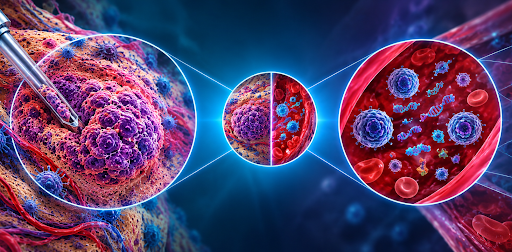
Header Image credit: created by author with OpenAI
Edited by Ana Isabel Castillo Orozco
References
- Ma, L., Guo, H., Zhao, Y. et al. Liquid biopsy in cancer: current status, challenges and future prospects. Sig Transduct Target Ther 9, 336 (2024). https://doi.org/10.1038/s41392-024-02021-w
- Biopsy: types of biopsy procedures used to diagnose cancer. Mayo Clinic. Dec. 24, 2025. https://www.mayoclinic.org/diseases-conditions/cancer/in-depth/biopsy/art-20043922
- Chen Z, Li C, Zhou Y, et al. Liquid biopsies for cancer: From bench to clinic. MedComm. 2023; 4:e329. https://doi.org/10.1002/mco2.329
- Adashek JJ, Janku F, Kurzrock R. Signed in Blood: Circulating Tumor DNA in Cancer Diagnosis, Treatment and Screening. Cancers. 2021; 13(14):3600. https://doi.org/10.3390/cancers13143600
- Vathiotis I, Banerjee A, Sen U, et al. Histologic Transformation in Cancer: The Path for Clinical Translation. Cancer Discov. 2025;15(9):1783-1793. https://pmc.ncbi.nlm.nih.gov/articles/PMC12412897/#ABS1
- Botticelli A, Cremolini C, Scagnoli S, et al. The Impact of Concordance between Liquid and Tissue Biopsy for Actionable Mutations: Insights from the ROME Trial. Clin Cancer Res. 2026;32(1):45-55. https://doi.org/10.1158/1078-0432.CCR-25-0430
- Pandey S, Yadav P. Liquid biopsy in cancer management: Integrating diagnostics and clinical applications. Pract Lab Med. 2024;43:e00446. Published 2024 Dec 24. https://pmc.ncbi.nlm.nih.gov/articles/PMC11743551/#sec9
- A study of blood-based biomarkers for pancreas adenocarcinoma. ClinicalTrials.gov identifier: NCT03334708 https://clinicaltrials.gov/study/NCT03334708


Leave a Reply