Reading time: 4 minutes
When you search online or hear explanations about how cancer develops, you have probably come across something along the lines of: “cancer arises when cells acquire mutations in their DNA that lead to uncontrolled proliferation.” This concept is correct. It describes the process of malignant transformation, in which a normal cell becomes a cancer cell, explaining how most cancers develop. Most, but not all.
Sarcomas are a rare group of cancers that differ from most solid tumors originating from organs like the lung, liver, brain (of epithelial origin), and arise from mesenchymal tissues such as bone, muscle, fat, and blood vessels. They account for only about one percent of adult cancers, yet they include more than seventy different subtypes. This makes them not only rare but also incredibly diverse.
One of the most surprising aspects of sarcomas is what they don’t have. In cancers, the disease is driven by a buildup of gene mutations—small changes in DNA that push cells to grow disorderedly. These mutations often act like “on switches” for cancer and are required for the transformation from healthy to cancerous tissue. However, most sarcomas break this rule. Instead of having lots of these mutations, they often have relatively stable DNA, with far fewer of the usual genetic changes seen in other cancers1.
So, if sarcomas don’t rely heavily on gene mutations, what drives them? In many cases, the answer lies in other types of changes to the genome. Some sarcomas are caused by pieces of DNA breaking and rejoining in unusual ways, creating what scientists call “fusion genes”. These fusion genes can act like powerful new instructions that tell cells to grow when they shouldn’t. Another sarcoma type is characterized by having dozens or even hundreds of copies of one (not mutated) gene 2,3,4. Yet, other sarcomas are influenced by changes in how genes are turned on or off, rather than changes in the genes themselves. This kind of regulation, known as epigenetics, adds another layer of complexity to the disease 5.
This unusual biology has important consequences, starting with diagnosis. For many common cancers, doctors can use genetic tests to quickly identify key mutations and confirm what type of tumor they are dealing with, and even provide information about the prognosis – the outcome – of that patient. In sarcomas, this is often not possible. Instead, diagnosis relies heavily on what the tumor looks like under a microscope (its morphological features), along with specialized laboratory tests. Because there are so many subtypes and many of them look similar, even experienced doctors can find sarcomas difficult to classify.
Sarcoma treatment is also shaped by the lack of mutations. In recent years, cancer care has been transformed by targeted therapies—drugs designed to target specific mutated proteins that drive growth or other important functions in the tumor. These treatments can be highly effective in cancers where those mutations are clearly defined, and they have the potential to produce fewer side effects in patients since it is a more tumor-focused approach. But in sarcomas, the absence of targetable mutations means that these options are more limited. As a result, many patients are still treated with more traditional approaches like surgery, radiation, and chemotherapy. While these treatments can be lifesaving, they are not as precise as targeted therapies, and outcomes can vary widely depending on the type of sarcoma and how advanced it is at diagnosis.
Another challenge is that sarcomas are rare, which makes research more difficult. Large clinical trials—the kind that lead to new standard treatments—are harder to organize and to produce significant readouts when there are fewer patients. This means progress can be slower compared to more common cancers.
One of the most exciting areas of research today involves the immune system. Our immune system is constantly on the lookout for abnormal cells, including cancer. In some cancers, especially those with many mutations, the immune system can recognize tumor cells as “foreign” and attack them. This has led to the development of immunotherapy, a type of treatment that helps the immune system do its job more effectively. However, sarcomas are not considered good candidates for immunotherapy because they tend to have fewer mutations, and therefore fewer obvious signals for the immune system to detect. On the positive side, a small number of sarcomas do show signs of immune activity, and clinical trials have shown that immunotherapy can work for some sarcoma patients 6. Scientists are hopeful and working to understand which patients are most likely to respond and how to make immunotherapy more effective for sarcoma.
In the end, sarcomas are the cancer type to best remind us that cancer is not a single disease but a collection of many different conditions, each with its own story. Their rarity and complexity make them difficult opponents, but they also push science to think creatively. And in that challenge lies the potential for discoveries that could benefit not only sarcoma patients, but cancer care as a whole.
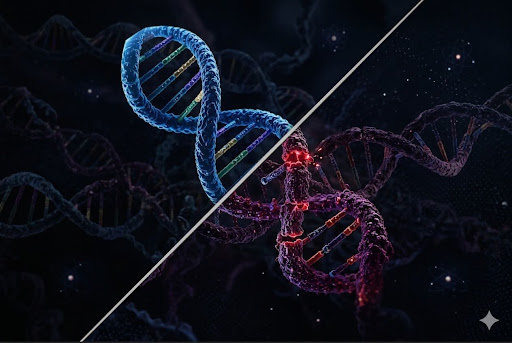
Header Image Credit: Mário M. de Queiroz
Edited by Dr Alina Panjwani
References
- Chalmers, Z.R., Connelly, C.F., Fabrizio, D. et al. Analysis of 100,000 human cancer genomes reveals the landscape of tumor mutational burden. Genome Med 9, 34 (2017). https://doi.org/10.1186/s13073-017-0424-2
- Krumbholz M, Hellberg J, Steif B, et al. Genomic EWSR1 fusion sequence as highly sensitive and dynamic plasma tumor marker in Ewing sarcoma. Clin Cancer Res. 2016;22(17):4356-4365.
- Hirose T, Ikegami M, Kojima S, Yoshida A, Endo M, Shimada E, et al. Extensive analysis of 59 sarcoma-related fusion genes identified pazopanib as a potential inhibitor to COL1A1-PDGFB fusion gene. Cancer Sci. 2023 Oct;114(10):4089-4100. doi: 10.1111/cas.15915. Epub 2023 Aug 17. PMID: 37592448; PMCID: PMC10551592.
- Thway K. Well-differentiated liposarcoma and dedifferentiated liposarcoma: An updated review. Semin Diagn Pathol. 2019 Mar;36(2):112-121. doi: 10.1053/j.semdp.2019.02.006. Epub 2019 Feb 28. PMID: 30852045.
- Nacev BA, Jones KB, Intlekofer AM, Yu JSE, Allis CD, Tap WD, Ladanyi M, Nielsen TO. The epigenomics of sarcoma. Nat Rev Cancer. 2020 Oct;20(10):608-623. doi: 10.1038/s41568-020-0288-4. Epub 2020 Aug 11. PMID: 32782366; PMCID: PMC8380451.
- Moreno Tellez C, Leyfman Y, D’Angelo SP, Wilky BA, Dufresne A. Immunotherapy in Sarcoma: Where Do Things Stand? Surg Oncol Clin N Am. 2022 Jul;31(3):381-397. doi: 10.1016/j.soc.2022.03.004. PMID: 35715140.


Leave a Reply