
Reading time: 4 minutes
Cameron Van Cleave
The bone marrow is more than just blood cells. It’s a complex mixture of blood vessels, stem cells, immune cells, and even fat cells.1 There is a lot of cross-talk between all these different cell types, adding an extra layer of complexity to blood cancers. For example, multiple myeloma, a plasma cell cancer marked by an overproduction of antibodies, is notorious for tricking other cells into creating a ‘sheltering effect,’ thus allowing cancer cells to resist treatment.2 Chronic lymphocytic leukemia (CLL), a slow-growing disease starting in white blood cells, has now taken this ‘sheltering effect’ literally, according to a recent collaboration between Northwestern University, University of Chicago, and the Fox Chase Cancer Center.3 The researchers noted that tumor and tissue biopsies of patients with particularly aggressive lymphomas sometimes contained cancer cells intact within other cells. While this phenomenon has been observed before, no one has been able to really explain how and why it relates to disease progression and resistance to therapy.
Because tumor and tissue samples are typically killed and fixed within paraffin, the researchers sought to develop a model where they could study this cell-in-cell phenomenon within a living system. They harvested CLL cells from patient bone marrow, blood, and lymph nodes, then plated the cells with bone marrow fibroblasts (BMF). Fibroblasts are large, structural cells known to encourage cancer cell survival which makes them a good candidate for observing live cell-in-cell.4 The researchers allowed the CLL cells and BMFs to grow for 5-7 days and then placed them under a powerful microscope for 3D imaging. Sure enough, up to 10% of CLL cells were partially or completely burrowed into BMFs. The researchers were also able to take time-lapse images watching CLLs actively tunnel into BMFs, sometimes even crawling back out.
Now that they had a model system, the question became: “What kind of patients exhibit more cell-in-cell events and why?” As it turns out, CLLs from patients who have already undergone treatment demonstrated more cell-in-cell events on average than untreated patients. The researchers narrowed the investigation to patients currently receiving Brutone tyrosine kinase inhibitors (BTKi), a treatment that specifically targets B cell development. They chose this patient group as BTKi’s are known to have a lower response rate to therapy, with cancer cells remaining after treatment. Researchers treated CLLs with the BTKi ibrutinib and observed that upon treatment, the number of cell-in-cell events greatly increased in CLLs harvested from patients who had already undergone BTKi treatment compared to CLLs taken from patients never exposed to BTKi’s. To put it in plain language, the resistant cancer cells used their environment to hide from a drug attack.
How do we fight back against sneaky CLL? The researchers tested several signaling receptors known to have a strong correlation with tumor growth. Think of these receptors as your phone and their ligands as a charging cable. While a few receptor-ligand pairs showed more cell-in-cell events, the researchers focused on a receptor called CXCR4, due to its abundance on the surface of CLL cells, and a ligand called CXCL12, which is released by multiple cell types present in the tumor microenvironment. There are clinically available drugs, like plerixafor and motixafortide, that specifically block CXCR4. When the researchers treated CLL cells with plerixafor, the number of cell-in-cell events decreased significantly. This held true when plerixafor was used in tandem with BTKi’s. Going back to the phone analogy, imagine sticking chewing gum in the charging port of your annoying neighbor’s phone so he can no longer attach a cable, thus preventing charging.
This amazing research developed an elegant model to observe live cell-in-cell events, which is a mechanism that CLL cells likely use to hide from chemotherapy. The researchers also found that plerixafor can prevent CLL cells from burrowing into fibroblasts for protection. Because plerixafor is already available in the clinic, it can be repurposed to treat CLL in tandem with BTKi. Not only does this save millions of dollars in drug development, it shaves years off of the time needed for clinical trials. To that end, this research may lead to a new treatment option for CLL patients much more quickly than developing a new drug from scratch. So for those of you out there with CLL, there is hope.
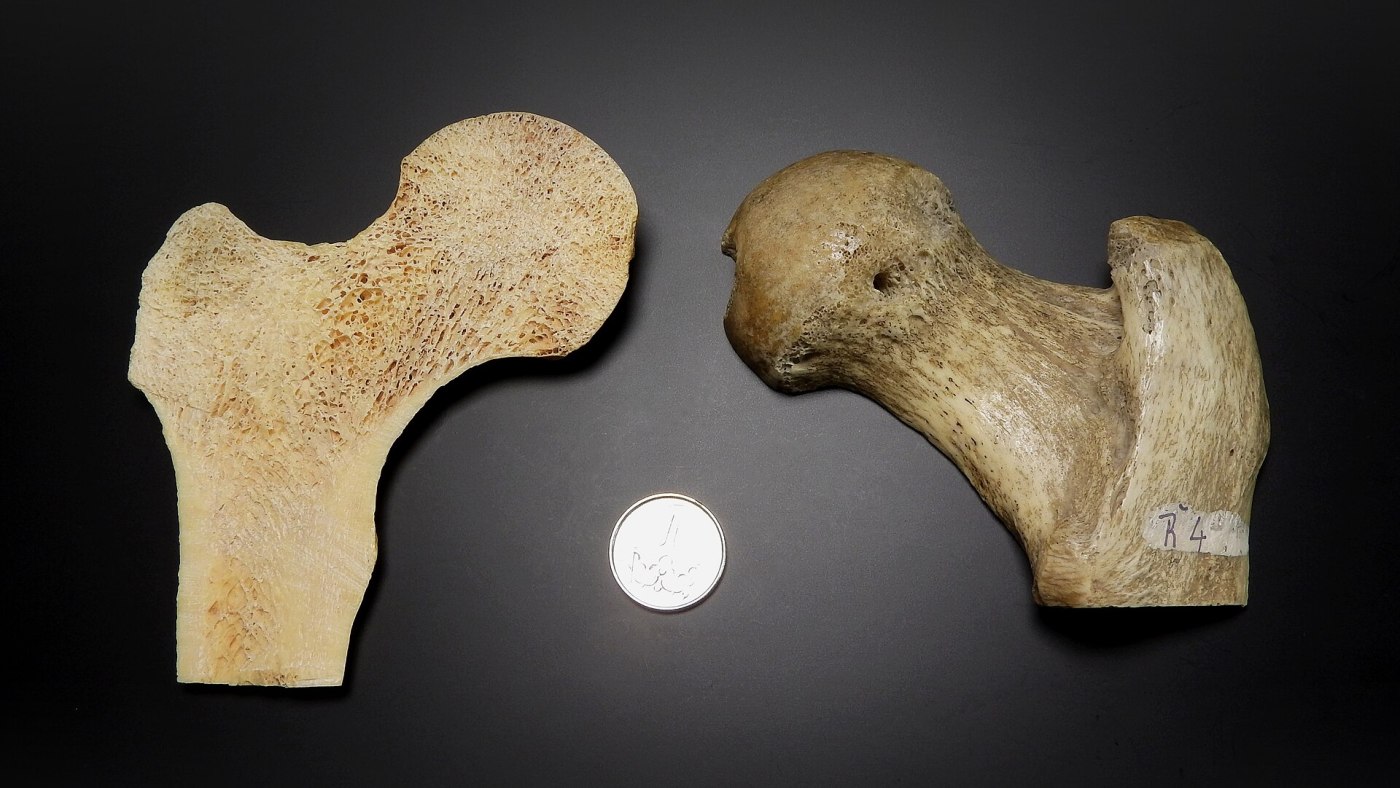
Header Image Caption and Source: Inner and outer structures of a human femur bone. From Wikimedia Commons (under a Creative Commons license).
Edited by Mia Hubert
References
1. Sánchez-Lanzas, R., Kalampalika, F., and Ganuza, M. (2022). Diversity in the bone marrow niche: Classic and novel strategies to uncover niche composition. Br. J. Haematol. 199, 647-664. 10.1111/bjh.18355.
2. Moser-Katz, T., Joseph, N.S., Dhodapkar, M.V., Lee, K.P., and Boise, L.H. (2020). Game of Bones: How Multiple Myeloma Manipulates Its Microenvironment. Front. Oncol. 10, 625199. 10.3389/fonc.2020.625199.
3. Lu, P., Franzen, C.A., Vistarop, A., Efimov, A., Shahriyar, S.A., Wang, S., Rao, S., Messmer, M., Nakhoda, S., Cukierman, E., et al. (2025). Shelter in place: live CLL cells inside bone marrow fibroblasts and its implication in residual disease persistence. Blood Neoplasia 2, 100142. 10.1016/j.bneo.2025.100142.
4. Frassanito, M.A., Rao, L., Moschetta, M., Ria, R., Di Marzo, L., De Luisi, A., Racanelli, V., Catacchio, I., Berardi, S., Basile, A., et al. (2014). Bone marrow fibroblasts parallel multiple myeloma progression in patients and mice: in vitro and in vivo studies. Leukemia 28, 904-916. 10.1038/leu.2013.254.


Leave a Reply