Reading time: 3 minutes
Colette Bilynsky
A significant portion of my PhD research was related to colorectal cancer (CRC), so I had seen in the academic literature that the incidence rate of CRC was increasing for people under 50 years of age. Despite this, I was still surprised when on my social media I started getting more and more posts about young people being diagnosed with colorectal cancer. On TikTok, whose primary demographics are young people, the colon cancer hashtag has over 941.2 million views. This prevalence brings into sharp reality that more and more young people are being diagnosed with colorectal cancer, which begs the question of why?
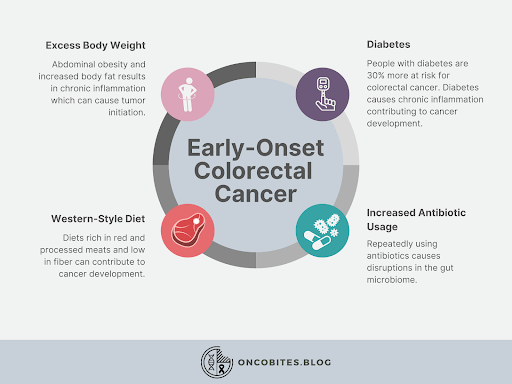
According to data released from the American Cancer Society, the incidence rate of colorectal cancer in young adults increased between 1-2% over the past year, and is now the deadliest type of cancer for young men and the second deadliest for young women[1]. What is particularly interesting is that its incidence is actually decreasing for people over 50 years of age[2]. There are a few risk factors that could be contributing to this increase for young people: western-style diet, excess body weight, diabetes, and increased antibiotic use. So let’s discuss each of these in more detail.
- Western-Style Diet
This type of diet typically contains lots of red and processed meat and a lower amount of fiber, most common in the United States and Northern Europe. This aligns with the areas that have experienced some of the largest increases in early-onset colorectal cancer incidence[3]. Furthermore, areas that typically do not follow western diets, like Africa and Asia have some of the lowest incidence rates of CRC[3]. Diet also affects the gut’s microbiota (healthy bacteria that helps with digestion) which can contribute to CRC tumor progression due to their impact on cell proliferation and the immune system [3].
- Excess Body Weight
Excess body weight is associated with an increased risk for colorectal cancer [2], [3]. The exact relationship is somewhat controversial. Some studies have more specifically identified abdominal obesity (using waist circumference or the waist-to-hip ratio as a metric) as opposed to overall excess body weight as a risk factor for CRC [4]. Other studies have said that specifically having higher body fat at a young age, instead of just increased weight, is associated with a higher risk of colon cancer, but not rectal cancer [2]. Increased adipose tissue, or fat tissue, causes constant chronic inflammation throughout the body. The signaling molecules released by adipose tissue during this inflammation can contribute to carcinogenesis by promoting more rapid cell proliferation and mutation [2].
- Diabetes
Patients with diabetes are about 30% more at risk than those without [2]. In studies on both Swedish and African American populations, diabetes has been associated with an increased risk of colorectal cancer [2], [5]. Similar to increased body fat, diabetes causes chronic inflammation, which, as previously described, can cause tumor initiation [5]. It is recommended that diabetic patients are screened 5 years earlier for colorectal cancer than for nondiabetic patients [2].
- Increased Antibiotic Usage
As you’ve probably gathered reading this article, gut microbiome plays a huge role in the risk or prevention of CRC. Taking antibiotics, especially repeatedly, can alter the gut microbiome in a way that’s associated with an increased risk of colorectal cancer [3]. The widespread and constant use of antibiotics has been increasing over the past several decades, which could contribute to some of the recent increase in early-onset CRC[3]
Overall, behaviors that can cause disruptions in the body’s microbiome like antibiotic usage and diet, but also drinking or smoking, are thought to contribute to the increased prevalence of CRC in young people [3]. Similarly, conditions that cause increased inflammation, like diabetes or high body fat, also contribute to the increased prevalence of CRC.
Edited by Antony Tao
Cited Sources:
 OncoBites
Leave a comment