Reading time: 4 minutes
Sunetra Sen, Ph.D.
Cell division is an organism’s natural mechanism of growth, renewal, and repair. Ironically, every time a cell divides, it carries a small but non-negligible risk of DNA damage that could spark a cancer-causing mutation. This implies that large mammals who have trillions of cells and lifespans of centuries will accumulate more mutations in their DNA, exposing them to an enormous risk of developing cancer during their lifetime [1]. However, this is challenged by a counterintuitive phenomenon called Peto’s paradox [2, 3]. The paradox observes that large, long-lived animals do not have a higher incidence of cancer compared to smaller, short-lived ones. The longest living mammals, the bowhead whales (Balaena mysticetus) weigh over 80,000 kilograms and have a lifespan of more than 200 years. Yet, they rarely develop cancer— a biological mystery that has puzzled scientists for decades.
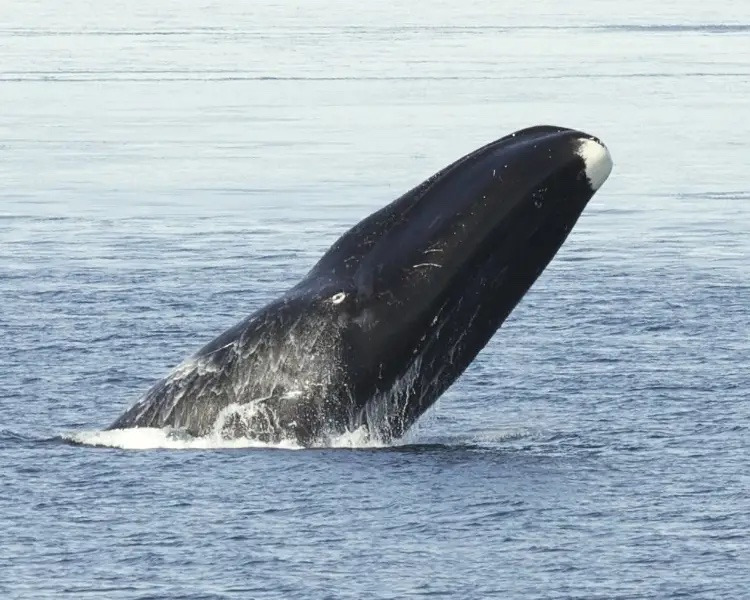
Image 1: “Nature’s Giants” unlocking clues to cancer treatment [Source: https://animalia.bio/bowhead-whale]
The answer to this mystery may have been found!
In a landmark study recently published in Nature, Firsanov et. al have reported the genetic underpinnings of low cancer incidence and remarkable longevity in bowhead whales [1]. As part of their initial investigation of whether whale cells are better equipped to resist cancer, the researchers triggered cancer-like mutations in primary fibroblast cells (connective tissue cells often used in laboratory studies) from bowhead whales and compared them with human cells. They expected bowhead cells to require more mutations to become cancerous. Instead, they found the opposite: bowhead cells actually required fewer mutational hits than human cells, to be transformed into malignant cells. These results were unforeseen and perplexing — until the researchers took a deeper look at DNA repair processes [1, 4, 5, 6].
Fixing the code through efficient DNA repair mechanisms
Further investigations revealed that bowhead whale DNA mutates at a significantly lower rate than the human DNA. Moreover, the bowhead whales utilize a protein they produce in abundance — the CIRBP (cold-induced RNA-binding protein) that excels at repairing broken DNA [1, 4, 5, 6].
CIRBP: A Cold-Activated Protein with Big Potential
Breaks in the DNA double helix are the predominant cause of DNA damage. When these breaks happen, cells activate quick DNA repair systems wherein broken DNA ends may often join incorrectly. This phenomenon, known as non-homologous end joining, can lead to mutations and increase the risk of cancer. On the other hand, homologous recombination repair is a slow but accurate process wherein the cell uses a matching copy of the DNA as a template to rebuild damaged DNA more precisely.
This study found that bowhead whale cells are particularly effective at repairing DNA using both quick and precise repair pathways [1]. This enhanced repair ability is linked to the highly expressed protein CIRBP. Importantly, CIRBP moves to the sites of DNA breaks, helps repair proteins to attach efficiently, and protects the broken DNA ends from resection.
Human cells engineered to overexpress CIRBP showed improved DNA repair capabilities and fruit flies overexpressing the protein experienced longer lifespans and greater resistance to radiation-induced damage. The study confirmed that the bowhead whale’s strategy of cancer resistance and longevity is rooted in better maintenance of the cells. Through efficient DNA repair facilitated by a dramatic increase in the levels of CIRBP, bowhead whale cells limit the accumulation of cancerous mutations rather than eliminating malignant cells [1, 4, 5, 6].
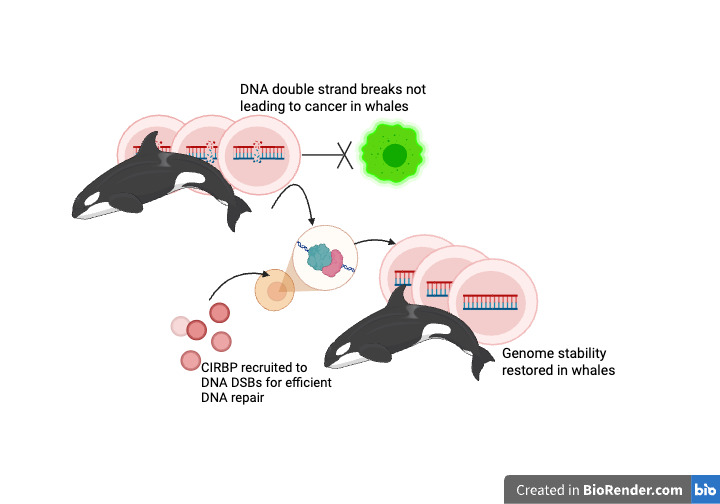
Image 2: CIRBP (cold-induced RNA-binding protein) excels at repairing broken DNA, a strategy that whales utilize for genome stability, cancer prevention and longevity. [Created in https://BioRender.com]
From Whales to Humans: What the Findings Could Mean for Science and Human Health
Bowhead whales may hold one of nature’s most sophisticated solutions to a problem that has long challenged scientists. For decades, detecting and destroying tumors once they have already formed in our bodies has been the mainstay of cancer treatment. However, the bowhead whale-derived solution is unique and emphasizes not just stronger defenses, but smarter cell maintenance in the form of preserving DNA integrity [1, 4, 5]. This supports both longevity and cancer prevention at its very origin. As research continues, understanding whether CIRBP’s mechanisms can be safely mimicked or enhanced in humans could open new avenues in cancer prevention through the development of gene therapies, preventative drugs and personalized DNA repair treatments.
Header Image Source: from animalia.bio (under Creative Commons license)
In-text Image 2 Source: created by author with Biorender
Edited by Madeline J. Morrisson
References
- Firsanov D, Zacher M, Tian X, Sformo TL, Zhao Y, Tombline G, Lu JY, Zheng Z, Perelli L, Gurreri E, Zhang L. Evidence for improved DNA repair in the long-lived bowhead whale. Nature. 2025 Oct 29:1-9. https://doi.org/10.1038/s41586-025-09694-5
- Dang CV. A metabolic perspective of Peto’s paradox and cancer. Philosophical Transactions of the Royal Society B: Biological Sciences. 2015 Jul 19;370(1673):20140223. https://doi.org/10.1098/rstb.2014.0223
- Vincze O, Colchero F, Lemaître JF, Conde DA, Pavard S, Bieuville M, Urrutia AO, Ujvari B, Boddy AM, Maley CC, Thomas F. Cancer risk across mammals. Nature. 2022 Jan 13;601(7892):263-7. https://doi.org/10.1038/s41586-021-04224-5
- https://www.npr.org/2025/11/24/nx-s1-5612550/bowhead-whale-cancer-dna-longevity
- https://www.forbes.com/sites/scotttravers/2025/11/14/meet-the-whale-that-just-brought-us-one-step-closer-to-curing-cancer-a-biologist-explains/
- https://www.urmc.rochester.edu/news/story/secret-to-a-long-life
 OncoBites
Leave a comment