Reading time: 6 minutes
Shashank Gidipally, PharmD.
Challenge of Bringing Precision Oncology to Skin Cancer Care in Community Settings
In the last decade, skin cancer treatment has gone under a big shift. At first, treatments were limited to surgery, radiation, and chemotherapy. Now, practitioners have access to targeted genetic therapies and immunotherapies that have dramatically improved survival rates, especially for advanced melanoma¹⁻³. Testing for the B-Raf Proto-Oncogene Serine/Threonine Kinase (BRAF) and Neoblastoma RAS viral oncogene homologue gene (NRAS) mutations, the use of targeted inhibitors and introduction of immune checkpoint inhibitors have scientifically redefined what’s possible for patients. ⁴⁻⁹. However, therapies that are possible in cutting-edge academic centers is not achievable or even accessible in community oncology clinics ¹⁰⁻¹². Precision oncology is advancing faster than the healthcare infrastructure meant to deliver it. This gap isn’t just a representation of a logistical hurdle, but more representative of real consequences for patient survival, quality of life, and health equity.
Precision Oncology: A Revolution in Skin Cancer Care
Skin cancer is the most common cancer in the United States. Melanoma accounts for the majority of skin cancer related deaths. Non-melonoma cancers such as basal cell carcinoma and squamous cell carcinoma contribute significantly to disease burden and healthcare costs. ³ Over the past 15 years, we have learned that these cancers are not biologically uniform. They are driven by specific molecular alterations that can be exploited therapeutically. For example, about 40–50% of melanomas harbor a BRAF V600 mutation, which can be targeted with BRAF and MEK inhibitors to improve overall survival.⁴⁻⁶ Immunotherapies such as anti-PD-1 and CTLA-4 inhibitors have also revolutionized treatment, with some patients achieving long-term remission.⁷⁻⁹ However, these treatments depend on precise timing and accurate molecular testing, appropriate patient selection, and multidisciplinary coordination, elements that are not present within a community practice.
Where the Gap Begins: Testing Infrastructure
In major academic centers, tumor testing is integrated into care workflows. A biopsy is obtained, and genomic testing is ordered reflexively. Pathologists, molecular biologists, and oncologists communicate rapidly, and treatment plans are often discussed in tumor boards with multiple subspecialists.
In contrast, in many community settings, genomic testing may require sending tissue to an external reference lab, with turnaround times ranging from 2 to 4 weeks.¹⁰⁻¹² During this time, many practitioners reluctantly are forced to provide empiric treatment without the basis of molecular results. This results in time lost, which may lead to loss in having many options. Furthermore, not all community practices have access to advanced testing platforms. While academic and research centers have access to advanced sequencing panels that can identify a broad range of actionable mutations, community clinics will have to rely on limited testing or have to forgo entirely due to the lack of costs and logistics.
Cost Barriers and Insurance Complexity
Precision oncology requires an abundance of resources. Genetic testing and targeted therapies are very expensive and often insurance may not cover these. ⁴ Patients may face significant out-of-pocket costs, and community clinics often lack dedicated financial navigators to help them work through prior authorizations and appeals. The issue is not just about financial stress. The underlying issue is the clinical impact. Patients who cannot afford or access molecular testing are less likely to be offered targeted therapies or immunotherapies. This creates a stratified system where the availability of treatment depends on geography and socioeconomic status.
Provider Knowledge and Educational Gaps
Precision oncology requires specialized knowledge in which mutations to test for, which assays to order, how to interpret the results, and how to integrate targeted therapies with surgery, radiation, and systemic treatments. While academic oncologists are often immersed in the system and may be useful for closing the gap, community practitioners who juggle a broader range of diseases may not have the same level of exposure. This contributes to the under-utilization of molecular testing. Even with testing being available, it is not always ordered due to the uncertainty about clinical utility or the uncertainty in perception. Bridging this educational gap is just as important to building infrastructure.
Real-World Evidence: A Powerful Lens for Change
One of the most transformative developments in modern oncology is the growing role of real-world evidence (RWE). RWE refers to data collected outside of traditional clinical trials, including electronic medical records (EMRs), disease registries, claims databases, and other sources that reflect routine clinical practice.¹⁶⁻¹⁸ Unlike randomized controlled trials (RCTs), which typically enroll highly selected patient populations under idealized conditions, RWE captures the complexity of actual patient experiences, encompassing diverse demographics, comorbidities, and care settings. This broader perspective provides insights into how therapies perform in the “real world,” beyond the controlled environment of a trial.
By analyzing EMR and registry data, researchers can identify systemic gaps and inefficiencies in care delivery. For example, RWE can uncover disparities in molecular testing or targeted therapy access among patients in rural areas, underserved communities, or lower socioeconomic groups. It can also highlight operational challenges such as delays in test turnaround times, inconsistencies in guideline adherence, or barriers to timely treatment initiation. These insights are critical, as such disparities can directly influence clinical outcomes, including progression-free and overall survival.
The utility of RWE extends beyond observational insights. Regulators and payers are increasingly incorporating RWE into decision-making processes. For instance, evidence derived from RWE can help validate the effectiveness and safety of therapies in populations underrepresented in clinical trials, supporting more inclusive and representative regulatory assessments.¹⁶⁻¹⁸ Moreover, pharmaceutical companies and healthcare systems are leveraging RWE to optimize care pathways, identify patients most likely to benefit from specific treatments, and assess long-term outcomes, ultimately informing strategies to enhance precision oncology.
When used strategically, RWE has the potential not only to advance scientific understanding but also to promote equity in cancer care. RWE has the potential for key opinion leaders to implement interventions that ensure all patients have access to high quality and personalized treatment. In this way, RWE provides a very powerful lens for shaping more equitable and effective oncologic care.
Closing the Gap: Practical Steps Forward
The transformation of skin cancer treatment is one of oncology’s greatest success stories, but it remains incomplete. To ensure that breakthroughs in precision oncology benefit everyone and not just a select few, the focus must now shift toward making these innovations accessible in real-world settings. Expanding molecular testing capabilities in community clinics through regional laboratory networks, telepathology, or centralized testing programs is a critical first step. At the same time, addressing cost barriers through improved reimbursement structures and better financial navigation can help ensure that testing and advanced therapies are not limited to those who can afford them.
Equally important is investing in provider education. By integrating continuing medical education opportunities, virtual tumor boards, and clinical decision-support tools into routine practice, community clinicians can be empowered to use precision medicine confidently and effectively. Real-world evidence should be leveraged strategically to identify where gaps are widest, guide resource allocation, and inform policy decisions. Finally, stronger partnerships between academic and community centers can create a more connected ecosystem in expertise, infrastructure, and innovation.
Together, these steps represent not just an evolution in how we deliver skin cancer care but a commitment to ensuring that precision oncology reaches every patient who can benefit from it.
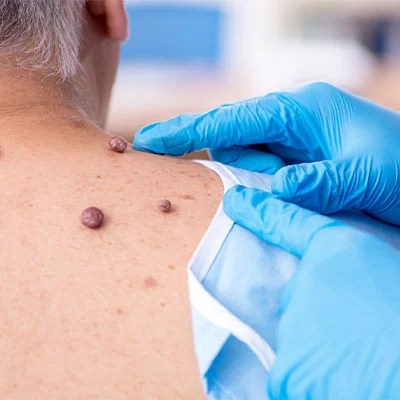
Header Image Source: Mole and Cyst Removal (CC BY-NC 4.0)
Edited by Sophia Park
References
- Luke JJ, Flaherty KT, Ribas A, Long GV. Targeted agents and immunotherapies: optimizing outcomes in melanoma. Nat Rev Clin Oncol. 2017;14(8):463-482.
- Schadendorf D, van Akkooi ACJ, Berking C, et al. Melanoma. Lancet. 2018;392(10151):971-984.
- Leiter U, Keim U, Eigentler T, et al. Incidence, mortality, and trends of nonmelanoma skin cancer in Germany. J Invest Dermatol. 2017;137(9):1860-1867.
- Long GV, Menzies AM, Nagrial AM, et al. Prognostic and clinicopathologic associations of oncogenic BRAF in metastatic melanoma. J Clin Oncol. 2011;29(10):1239-1246.
- Chapman PB, Hauschild A, Robert C, et al. Improved survival with vemurafenib in melanoma with BRAF V600E mutation. N Engl J Med. 2011;364(26):2507-2516.
- Larkin J, Ascierto PA, Dréno B, et al. Combined vemurafenib and cobimetinib in BRAF-mutated melanoma. N Engl J Med. 2014;371(20):1867-1876.
- Robert C, Schachter J, Long GV, et al. Pembrolizumab versus ipilimumab in advanced melanoma. N Engl J Med. 2015;372(26):2521-2532.
- Larkin J, Chiarion-Sileni V, Gonzalez R, et al. Combined nivolumab and ipilimumab or monotherapy in untreated melanoma. N Engl J Med. 2015;373(1):23-34.
- Hamid O, Robert C, Daud A, et al. Five-year survival outcomes for patients with advanced melanoma treated with pembrolizumab in KEYNOTE-001. J Clin Oncol. 2019;37(30):2518-2527.
- DiGiovanna JJ, Katayama I, Kido-Nakahara M, et al. Real-world implementation of precision medicine in community oncology. Oncologist. 2021;26(10):e1862-e1871.
- Khozin S, Blumenthal GM, Pazdur R. Real-world data for clinical evidence generation in oncology. J Natl Cancer Inst. 2017;109(11):djx187.
- Meric-Bernstam F, Brusco L, Shaw K, et al. Feasibility of large-scale genomic testing to facilitate enrollment onto genomically matched clinical trials. J Clin Oncol. 2015;33(25):2753-2762.
- Schadendorf D, Fisher DE, Garbe C, et al. Melanoma. Nat Rev Dis Primers. 2015;1:15003.
- Carlson JJ, Canestaro WJ. The economic burden of precision oncology. J Clin Oncol. 2017;35(23):2764-2766.
- Kehl KL, Lathan CS, Johnson BE, Schrag D. Race, socioeconomic status, and access to molecular testing. J Clin Oncol. 2019;37(14):1229-1239.
- Sherman RE, Anderson SA, Dal Pan GJ, et al. Real-world evidence—what is it and what can it tell us? N Engl J Med. 2016;375(23):2293-2297.
- Khozin S, Corrigan-Curay J, Pazdur R. Real-world evidence to support regulatory decision making: the need for transparency. JAMA Oncol. 2018;4(12):1625-1626.
- Corrigan-Curay J, Sacks L, Woodcock J. Real-world evidence and real-world data for evaluating drug safety and effectiveness. JAMA. 2018;320(9):867-868.
 OncoBites
Leave a comment