

Reading time: 3 minutes
Melanie Padalino
On February 3, 2023, a freight train carrying a large amount of vinyl chloride (a carcinogen) derailed in East Palestine, Ohio. The “clean-up” consisted of a controlled burn of the vinyl chloride, but this in turn generated a host of other hazardous chemicals including hydrogen chloride and phosgene which were released into the atmosphere. But it’s not just incidents like this one that contribute to air pollution. It’s also motor vehicles, power plants, factories, and wildfires just to name a few. While the train derailment left me feeling helpless, it made me think more deeply about how air quality impacts human health and ways in which it can be improved.
Outdoor air pollution poses an urgent public health challenge on a global level. A variety of outdoor air pollutants exist and they include both gaseous molecules and particulate matter (PM). Scientific evidence suggests that there is a link between PM and lung cancer incidence/mortality. While smoking is undoubtedly the most common cause of lung cancer, it’s important to note that genetics, radiation, and environmental contaminants can play a role as well (1).
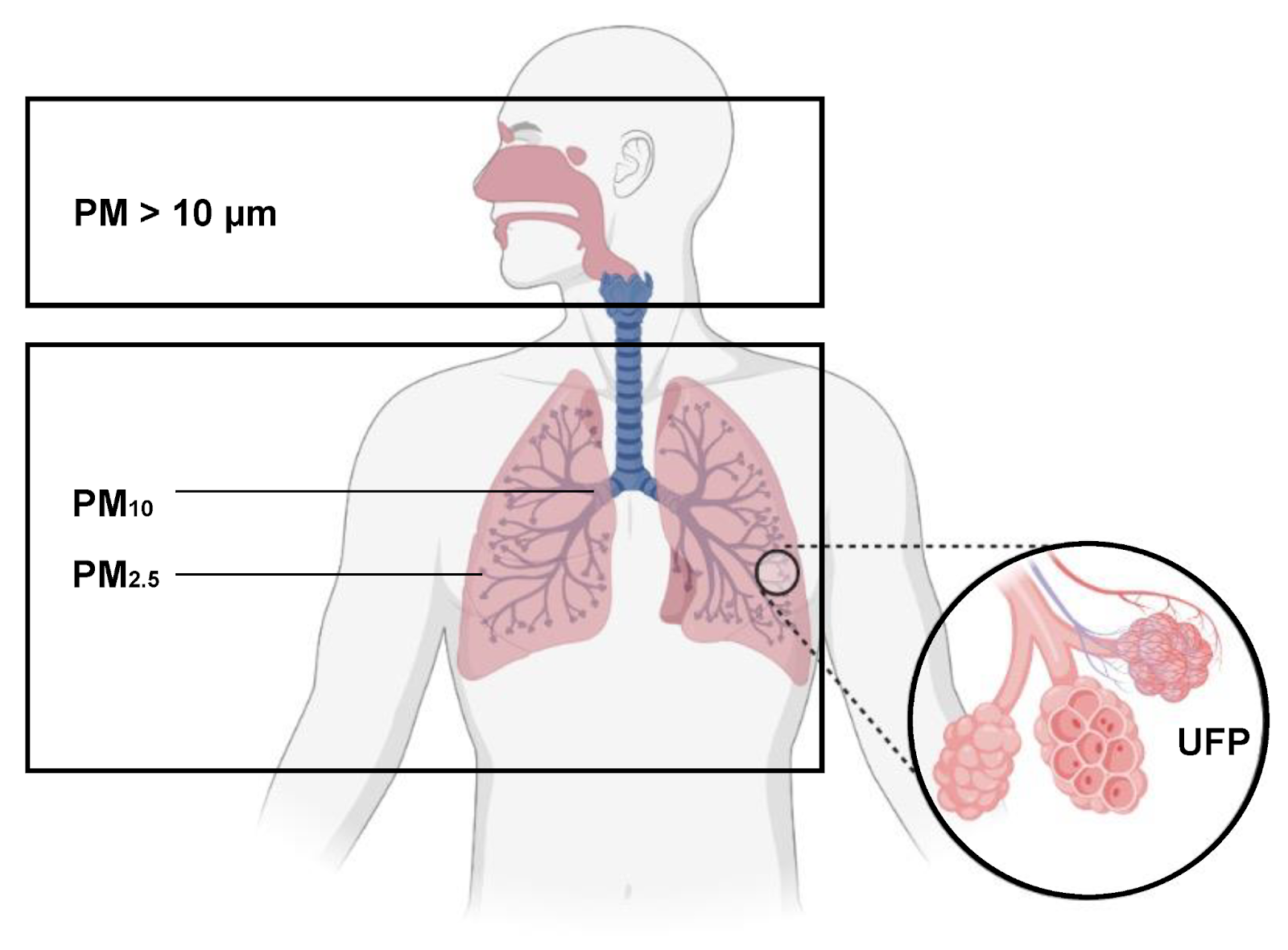
PM is a broad class of aerosols containing solid particles or liquid droplets suspended in the air. PM2.5 and ultrafine particles (UFPs) are perhaps the most concerning. With aerodynamic diameters of under 2.5 micrometers and .1µm respectively, these tiny particles can easily be inhaled, which allows them to permeate deep into the lungs. More specifically, these particles can nestle into the alveoli sacs which are critical for oxygen and carbon dioxide exchange (Figure 1).
So how do these particles actually induce lung cancer? The specific, biological mechanisms of this process remain somewhat elusive. However, it’s believed that inflammation and oxidative stress inflicted by the PM can lead to DNA mutations, abnormal cell proliferation, and ultimately cancer (Figure 2) (3). Some evidence suggests that PM2.5 can silence TP53, a tumor suppressor gene that influences a variety of processes such as cell proliferation, apoptosis, and damage repair (4). If inactivated or mutations are acquired, TP53 can contribute to the onset of lung cancer. (5)

While there is still much to learn about this process, the correlation is clear. For example, in 2016, researchers in Hong Kong and the UK studied the effect of long-term exposure to PM2.5 from various sources including transportation and power generation. It was found that this type of pollution increases the risk of mortality for a variety of cancers (6). In addition, Yu et al. demonstrated that the number of somatic mutations from air-pollution induced lung cancer in Xuanwei City (a region of China with severe air pollution from the combustion of smoky coal) was three times higher than in lung cancers from control regions where smoky coal was not used (7).
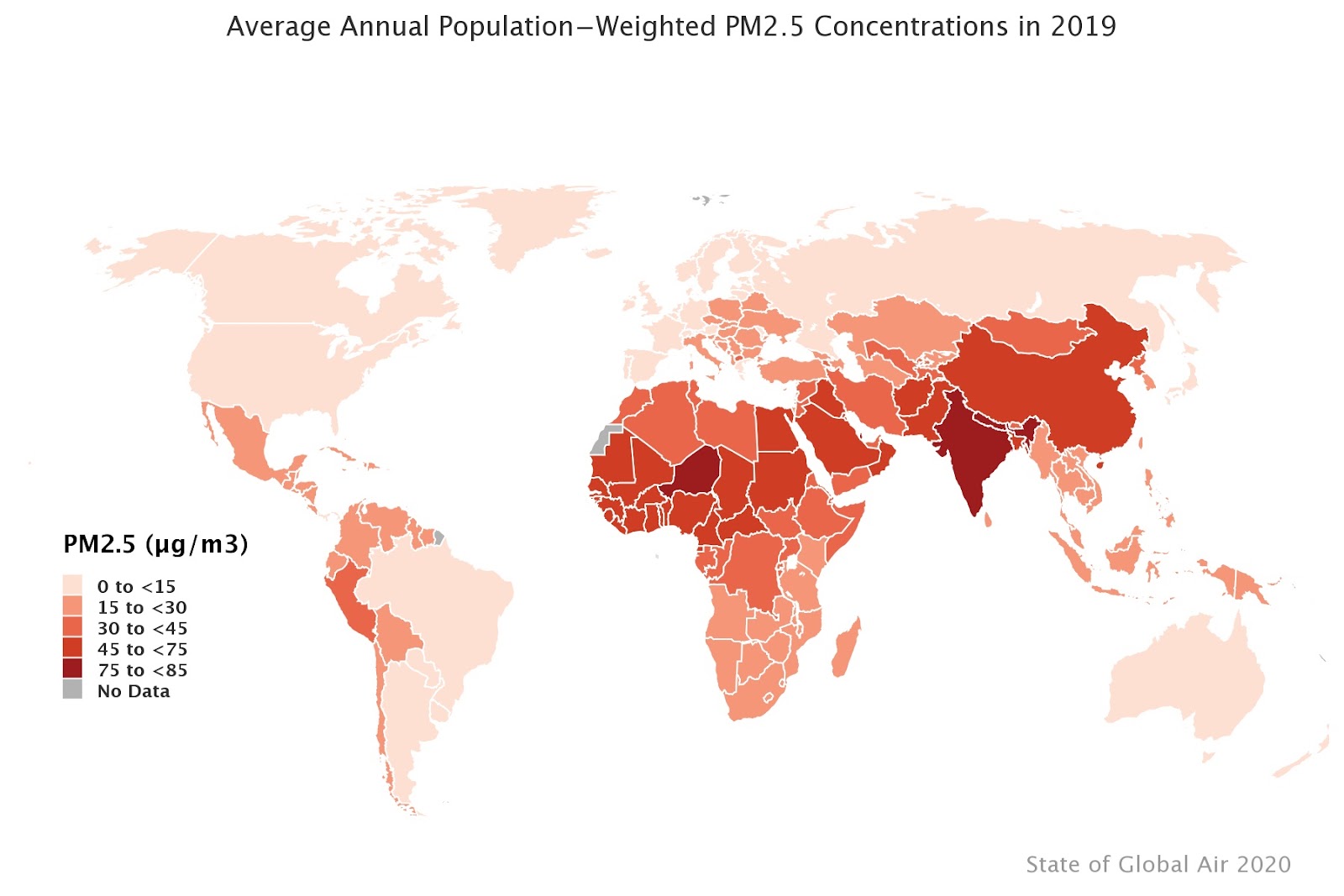
The amount of PM2.5 in the air varies drastically across the globe, but is perhaps most prevalent in low and middle income countries (Figure 3) (8). This is relevant because the incidence of adverse effects is highly dependent on the concentration of PM2.5 in the air and the time of exposure.
To mitigate risks associated with PM2.5, high-quality respirators and house filtration systems can be used to filter out the particles. But to actually make widespread changes will require a societal paradigm shift to greener practices when it comes to things like transportation and biomass burning. While so much seems out of our hands, it’s advocacy, policy, and public health recommendations that can drive the change we need. As science continues to unravel more about how air quality impacts our well-being, we’ll become more knowledgeable… and it might inspire people to call for change.
Disclaimer: This article is not a substitute for medical advice.
Edited by Ana Isabel Castillo Orozco
References
- Lung cancer overview. https://www.aacr.org/patients-caregivers/cancer/lung-cancer/ (accessed Apr 24, 2023).
- Goossens, J.; Jonckheere, A.-C.; Dupont, L. J.; Bullens, D. M. Air Pollution and the Airways: Lessons from a Century of Human Urbanization. Atmosphere 2021, 12 (7), 898.
- Turner, M. C.; Andersen, Z. J.; Baccarelli, A.; Diver, W. R.; Gapstur, S. M.; Pope, C. A.; Prada, D.; Samet, J.; Thurston, G.; Cohen, A. Outdoor Air Pollution and Cancer: An Overview of the Current Evidence and Public Health Recommendations. CA: A Cancer Journal for Clinicians 2020, 70 (6), 460–479.
- Zhou, W.; Tian, D.; He, J.; Wang, Y.; Zhang, L.; Cui, L.; Jia, L.; Zhang, L.; Li, L.; Shu, Y.; Yu, S.; Zhao, J.; Yuan, X.; Peng, S. Repeated PM2.5 Exposure Inhibits Beas-2b Cell p53 Expression through ROS-Akt-DNMT3B Pathway-Mediated Promoter Hypermethylation. Oncotarget 2016, 7 (15), 20691–20703.
- Olivier, M.; Hollstein, M.; Hainaut, P. TP53 Mutations in Human Cancers: Origins, Consequences, and Clinical Use. Cold Spring Harbor Perspectives in Biology 2009, 2 (1).
- Wong, C. M.; Tsang, H.; Lai, H. K.; Thomas, G. N.; Lam, K. B.; Chan, K. P.; Zheng, Q.; Ayres, J. G.; Lee, S. Y.; Lam, T. H.; Thach, T. Q. Cancer Mortality Risks from Long-Term Exposure to Ambient Fine Particle. Cancer Epidemiology, Biomarkers & Prevention 2016, 25 (5), 839–845.
- Yu XJ, Yang MJ, Zhou B, Wang GZ, Huang YC, Wu LC, Cheng X, Wen ZS, Huang JY, Zhang YD, Gao XH, Li GF, He SW, Gu ZH, Ma L, Pan CM, Wang P, Chen HB, Hong ZP, Wang XL, Mao WJ, Jin XL, Kang H, Chen ST, Zhu YQ, Gu WY, Liu Z, Dong H, Tian LW, Chen SJ, Cao Y, Wang SY, Zhou GB. Characterization of Somatic Mutations in Air Pollution-Related Lung Cancer. EBioMedicine. 2015 Apr 7;2(6):583-90.
- State of Global Air. https://www.stateofglobalair.org/data/#/air/map (accessed Apr 24, 2023).
Header image from unsplash.com
 OncoBites
Leave a comment