
Reading time: 5 minutes
Yonika Larasati
Accumulating knowledge shows that cancer cells do not thrive in isolation. Just as seeds need suitable soil to flourish into plants, cancer cells might perish without an appropriate environment. This environment, known as the tumor microenvironment (TME), has become an emerging trait of cancer that can be a target for cancer therapy. The TME is a complex mixture of cancer cells, non-cancer cells (stromal cells), immune cells, and biochemical substances such as proteins (1).
Due to their rapid growth, cancer masses do not have access to proper blood vessels. Cancer cells have to survive under stress, in an oxygen and nutrient-limited environment. In recent decades, another fascinating trait of cancer cells has been revealed; they can trick their surroundings, influencing the TME to support their growth.
Collagen, a group of proteins often promoted as a nutritional supplement for skin and joint health, is the most abundant protein in our body. Recently, a team of researchers at the National Cancer Institute, USA shed new insight into the role of collagen in cancer growth and how to exploit it for cancer therapy (2).
Collagen is abundant in the TME
Collagen is a group of proteins that form connective tissues; providing support, and protection, as well as giving structure to other tissues and organs in the body. Collagen is mainly produced by fibroblast cells.
Collagen makes up 25-35% of the total protein in the human body. While mostly found in cartilage, bones, tendons, ligaments, and skin; it is not a surprise that collagen is also abundantly present in the TME (3).
Can collagen, which is ubiquitous in the TME, be used as an alternative fuel source for tumor growth when nutrients are limited? Can cancer cells directly use collagen as nutrients, or do other cells in TME help cancer cells absorb collagen?
Tumor Endothelial Marker 8 (TEM8): sensor of collagen
Collagen is a huge protein therefore cells can not directly absorb collagen and need to ‘engulf’ this protein in a process called endocytosis. To perform collagen endocytosis, cells need another protein on the cell surface that can recognize the presence of collagen outside the cells, then direct cells to engulf it.
Using mice-bearing tumors, researchers found Tumor Endothelial Marker 8 (TEM8) as the key protein that recognizes collagen (2). Interestingly, they did not find cancer cells to express high levels of TEM8. Instead, TEM8 was expressed in stromal cells of the TME, especially in endothelial and fibroblast cells. The highest levels of TEM8 were found in stromal cells neighboring cancer cells, indicating that tumor-induced stress might regulate TEM8 expression in stromal cells.
Through experimentation, researchers verified that TEM8 can directly bind collagen. To confirm if TEM8 is essential for collagen recognition and uptake into the stromal cells, Hsu and colleagues labeled collagen with a fluorescent protein so they could observe collagen uptake into cells. They cultured cells expressing TEM8 and added fluorescently-labeled collagen in the culture. They then visualized how much collagen was left extracellularly after overnight incubation using a fluorescent microscope. Fluorescently-labeled collagen was minimally found extracellularly; instead, it was found inside cells expressing TEM8. These results imply that TEM8 binds and transports collagen inside the cells.
What happens to collagen inside the stromal cells?
Increased expression of TEM8 in stromal cells indicates that TEM8/collagen interaction might serve as a coping mechanism to overcome environmental stress faced by cancer cells. To support their massive growth, cancer cells can modify their metabolism. An example is the consumption of glutamine, an amino acid important for biosynthesis. Healthy cells produce their own glutamine. On the other hand, cancer cells consume glutamine from their surrounding environment in addition to their own production, making them ‘glutamine addicts’ (4). This glutamine abundance is used as the building block for new cancer cells.
Based on this knowledge, researchers then evaluated collagen metabolism in stromal cells. Indeed, they found that collagen was digested into glutamine. Glutamine was then released from stromal cells and consumed by cancer cells to fuel their growth (Fig.1).

Can we target TEM8/collagen function for anticancer therapy?
The interaction and functionality of TEM8/collagen in stromal cells might be exploited for cancer therapy. If TEM8 function in stromal cells can be blocked, cancer cells will lose their alternative fuel, glutamine. To test this, researchers developed an antibody against TEM8 that will inhibit its function. In cell culture, TEM8 antibody blocked collagen uptake into the cells. In a mouse model of colon cancer, TEM8 antibody inhibited cancer growth. This antibody reduced metastasis, the spreading of cancer cells to distant organs, which is responsible for the majority of cancer-related deaths. The antibody also complements the anticancer effect of a diverse group of clinically available chemotherapy drugs.
Take home message
In summary, collagen uptake by TEM8 in stromal cells has been characterized as a novel mechanism in which cancer cells modify TME to support cancer growth. Antibody inhibiting the function of TEM8 exhibits a promising preclinical anticancer profile without obvious toxicity within the timeframe of the experiment. Future studies should evaluate the long-term effect of TEM8 inhibition, as well as optimize the formulation of antibody against TEM8 to ensure the translatability of preclinical results into a clinical setting.
Edited by Aya Elmeligy
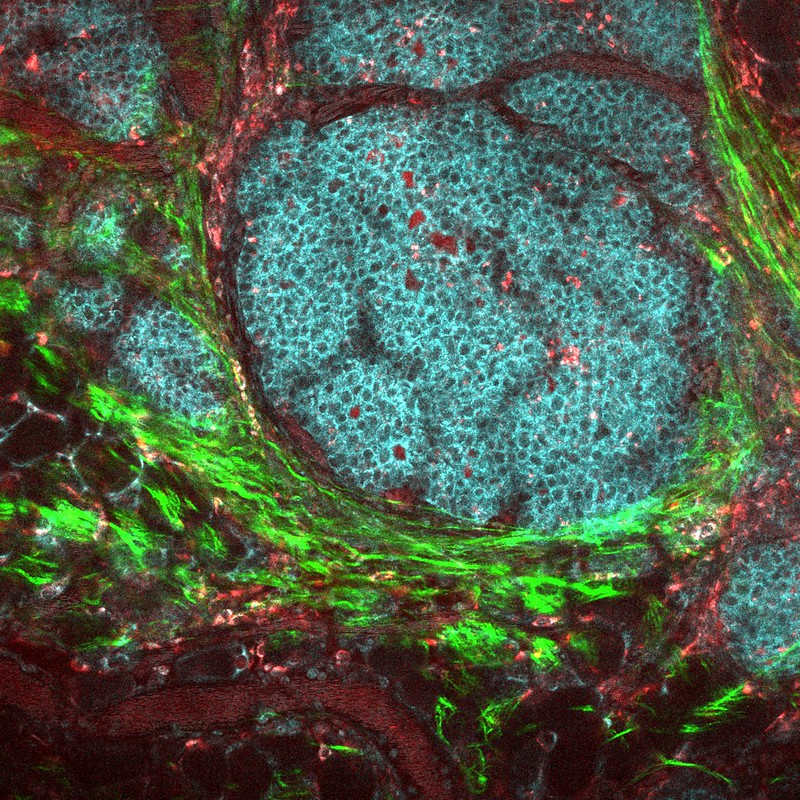
Header Image: Breast tumor microenvironment (source: NIH photo gallery)
References:
1. Anderson NM, Simon MC. The tumor microenvironment. Curr Biol. 2020 Aug 17;30(16):R921–5.
 OncoBites
Leave a comment